


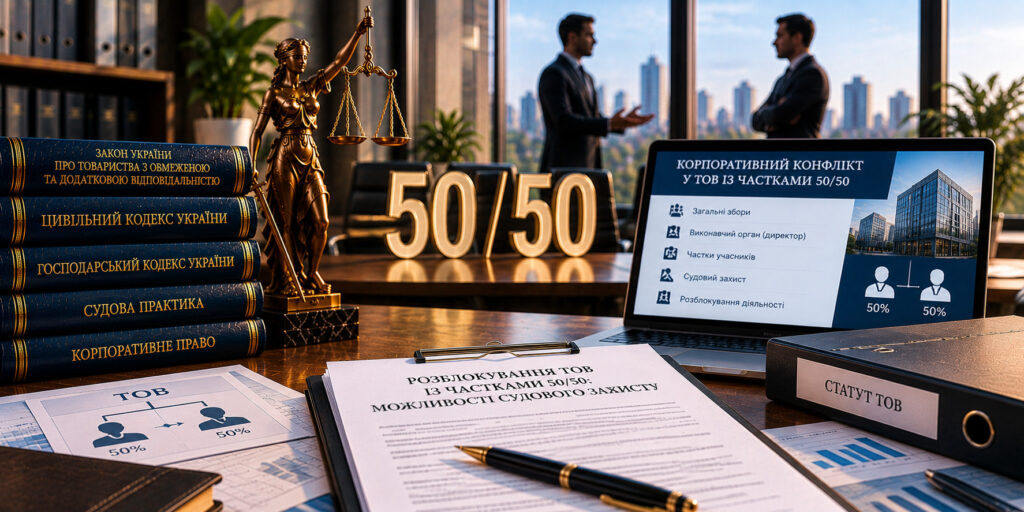
Two participants each own 50% of a Ukrainian limited liability company. They can no longer agree, there is no corporate agreement containing a mechanism for resolving the conflict, neither participant is able to sell or withdraw on acceptable terms, and decisions requiring the necessary voting majority cannot be adopted.
A natural question follows: can one of the participants go to court and have the company unblocked?
The answer depends on what exactly has been blocked.
A court can protect a specific infringed corporate right and, in certain circumstances, may intervene in a dispute involving the company’s executive body. What a court cannot normally do is create the missing votes, take over the powers of the other 50% owner or decide the company’s strategic direction instead of the general meeting.
For a company owned 50/50, this distinction is fundamental.
Why 50/50 ownership can block company management
Ukrainian company law requires different voting thresholds depending on the matter being decided by the general meeting.
Some decisions require a majority of all votes, while others require three quarters of the votes or unanimity.
If an LLC has only two participants and each owns exactly 50%, neither of them can independently provide the voting majority required for many material corporate decisions.
The Supreme Court has already considered the legal consequences of such a structure. In case No. 902/1256/20, the Court proceeded from the principle that a 50/50 allocation of ownership interests means equal participation of both owners in company management and requires their joint consent for the relevant decisions.
This is important because a 50/50 conflict does not necessarily mean that one of the participants has acted unlawfully.
Both owners may be exercising their corporate rights lawfully while taking completely opposite positions on the future of the business. Legally, this is very different from a case involving an unlawful corporate resolution, deprivation of an ownership interest, denial of access to documents or another identifiable infringement.
Can a court make a corporate decision instead of the participants?
The absence of the required number of votes does not automatically transfer a matter from the general meeting to the court.
Where Ukrainian law or the company’s charter reserves a decision for the general meeting, the court should not effectively become a third participant and decide which owner’s business position is more reasonable or commercially preferable.
The Supreme Court has confirmed this approach, including in case No. 922/2145/21. A claim whose practical effect would have been to make the court adopt a decision instead of the company’s governing body was treated as an inappropriate method of judicial protection.
In other words, court proceedings cannot simply provide a 50% owner with the votes missing at the general meeting.
This matters for decisions concerning amendments to the charter, changes to capital, distribution of profits, reorganisation or termination of the company and other matters reserved by law or the charter for the general meeting.
Where the relevant decision requires the joint will of both 50% owners, a court judgment does not normally replace that joint will.
Why a court cannot simply terminate the 50/50 conflict
In practice, one owner may expect the court to remove the other participant from the company, allow unilateral withdrawal or otherwise force the partners to separate.
Ukrainian law does not provide a general judicial power to change the ownership structure simply because the relationship between two equal owners has broken down.
A participant may be excluded only in the cases and under the procedure provided by law. A serious conflict between two 50% owners is not in itself sufficient to deprive one of them of an ownership interest merely because joint management has become impossible.
Unilateral withdrawal is also not always available.
As a general rule, a participant holding 50% or more may withdraw from the LLC only with the consent of the other participants, unless the company’s charter validly provides otherwise in advance. In a classic 50/50 structure, the other owner’s refusal to provide consent may therefore block this route as well.
Nor is compulsory liquidation a universal solution. A corporate conflict between two equal owners is not, by itself, a general statutory ground allowing one participant to obtain judicial liquidation of the LLC.
The practical result can therefore be difficult: the company continues to exist, both participants continue to own 50%, yet neither can independently secure the adoption of the required corporate decisions.
Where court protection may still be available
The analysis changes when the dispute concerns more than a simple disagreement between the owners and involves a specific violation of a right.
A court may review the legality of corporate resolutions, restore rights relating to an ownership interest, examine unlawful registration actions, protect rights to company information, enforce obligations arising from a corporate agreement and address other identifiable infringements.
This means that before filing a claim, it is necessary to identify not only the existence of a 50/50 conflict but also the particular right that has been infringed and the result that a court judgment can realistically achieve.
A separate issue arises when the participants’ conflict begins to block the company’s day-to-day business through its executive body.
When the problem concerns the director
The executive body of a Ukrainian LLC is responsible for managing the company’s current activities within the limits of its authority.
The director or another executive body manages the company’s day-to-day operations. For that reason, a situation in which the company is effectively paralysed through the conduct or inactivity of its director differs from a disagreement between the participants about strategic matters reserved for the general meeting.
This distinction became particularly relevant in case No. 904/2253/24.
The company in that case also had two participants, each holding 50%. One of them simultaneously performed the functions of director.
The other participant argued that the director had failed for a prolonged period to perform necessary management actions, that the company’s activity had effectively become blocked and that replacing the director through the general meeting was impossible because the votes were divided equally.
The first-instance and appellate courts dismissed the claim, relying in part on the fact that the appointment and termination of the director fall within the competence of the general meeting.
The Supreme Court considered that approach potentially too formalistic.
The lower courts were required to examine whether the claimant had actually exhausted the available corporate mechanisms for replacing the director and whether, given the 50/50 ownership structure, there was any realistic possibility of resolving the issue outside court.
In such exceptional circumstances, a claim seeking termination of the director’s powers together with a solution as to who would temporarily perform the functions of the executive body may constitute an appropriate and effective method of judicial protection.
There is, however, no final answer in that case yet.
The Supreme Court did not appoint a new director and did not finally uphold the claimant’s demands. It set aside the previous judgments and remitted the dispute for a new hearing.
For that reason, case No. 904/2253/24 should not be treated as a ready-made mechanism for resolving every 50/50 conflict. At present, it is better understood as an important judicial direction in a specific situation where the executive body itself may have become part of the mechanism blocking the company’s activity.
What if the director is not the other 50% owner?
In practice, the director may own no interest in the company at all but may still support one of the two participants or act consistently with that participant’s position.
That scenario requires a separate legal assessment.
An allegation that the director is “controlled” by one of the owners is not, by itself, sufficient to justify replacing the director at the request of the other 50% participant.
Case No. 904/2253/24 involved a more specific structure: the director was simultaneously the second 50% participant.
Where the director is a separate person, it is necessary to identify the director’s specific conduct or inactivity, the scope of the director’s authority, the nature of the alleged infringement and the particular right that requires judicial protection.
The Supreme Court’s new approach should therefore not automatically be extended to every case in which a director is perceived as aligned with one of the two owners.
What can changing the director solve — and what remains unresolved?
Even if the possibility of judicial termination of the director’s powers is ultimately confirmed after the new hearing in case No. 904/2253/24, this would not eliminate the underlying 50/50 ownership structure.
A change of director may potentially restore the company’s current business operations within the executive body’s authority.
A new or temporary director may be able to organise the company’s daily work, ensure performance of existing contracts, deal with employees, reporting, bank accounts and other operational matters to the extent that those matters do not require approval by the general meeting.
The ownership interests, however, would remain unchanged at 50/50.
When the next matter arises that requires a decision of the general meeting and the statutory or charter majority cannot be reached without both participants, the same conflict may appear again.
Accordingly, changing the director may in certain circumstances restore the functioning of the executive body, but it does not give one participant corporate control over the other and does not change the voting rules.
Can a court completely resolve a 50/50 conflict?
As of October 2026, Ukrainian legislation does not establish a separate universal judicial mechanism allowing a commercial court, merely because two 50% owners are in a persistent conflict, to decide which of them should control the business, compel a transfer of ownership between them or determine which strategic decision the company must adopt.
If one participant has infringed a specific right of the other, that right may be protected in court.
If the company’s activity is effectively paralysed because of a specific problem involving the executive body, recent Supreme Court practice leaves room for developing an appropriate judicial remedy.
But where two equal owners simply hold incompatible positions on a matter reserved for the general meeting, the court does not become the casting vote.
For that reason, the purpose of any proposed claim must be identified carefully.
If the objective is to restore the company’s current operations because they have been blocked by the conduct or inactivity of the director, a judicial route may, depending on the circumstances and evidence, have a realistic legal basis.
If the objective is to obtain the right to determine the company’s strategy unilaterally while the 50/50 ownership structure remains in place, Ukrainian law currently provides no general court mechanism for achieving that result.
This is also why the risk of a 50/50 management conflict is best addressed before relations between the owners break down. A properly structured charter and corporate agreement can define mechanisms to be used if the participants later become unable to adopt key decisions.
Where a conflict has already arisen, the lawyers of Grandliga can review the company’s charter, the authority and conduct of its director and the factual circumstances of the dispute, determine whether there is a specific basis for legal assistance in a corporate and commercial dispute, and, for preventive purposes, assist with preparing a corporate agreement and other mechanisms designed to reduce the risk of future management blockage.