



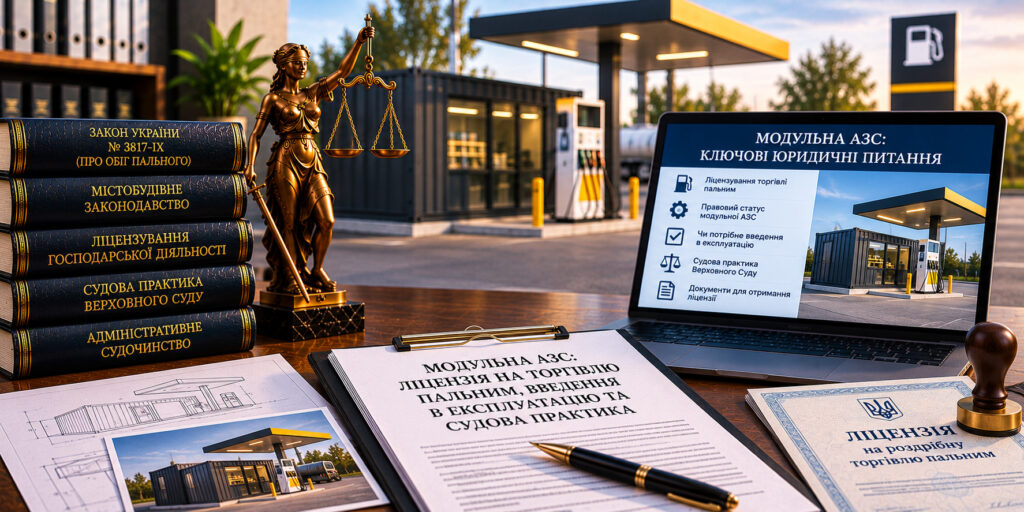
A business installs a factory-made modular filling station, prepares the technical documents for the equipment and applies to the Ukrainian tax authority for a retail fuel licence. The authority then requests a document confirming that the facility has been commissioned, or refuses to issue the licence because such a document has not been provided. The practical question is whether a modular filling station must be commissioned as a completed construction object where it is installed without a foundation and is, in substance, factory-manufactured technological equipment.
The answer does not depend on the label “modular filling station” alone. The legal assessment may turn on the design of the facility, the way it is installed, whether a foundation or construction works are involved, the composition of the equipment, the documents for the land plot and the technical documentation. Supreme Court practice shows that apparently similar situations may lead to different outcomes because of differences in the underlying facts.
What changed in fuel licensing
Since 1 January 2025, the principal rules governing fuel licensing in Ukraine have been set by Law No. 3817-IX. To obtain a retail fuel licence, an applicant must confirm the legal basis for using the place of trade and provide the documents required by law in relation to the facilities located there.
For modular filling stations, the legal status of the particular property is crucial. The current regime contains separate requirements concerning real estate located at the place of retail fuel trade and used for that activity. If a particular element of the filling station complex qualifies as a completed construction object, commissioning documents may be required. Where the element is instead factory-made technological equipment that does not qualify as a construction object, the legal position may be different.
For this reason, in a dispute with the tax authority it is not enough simply to rely on the wording used in the technical passport. The legal status of the fuel module itself, as well as the status of the other facilities actually located at the place of trade, must be assessed.
Why a modular filling station is not always a construction object
The distinction between a stationary filling station complex and modular equipment is not determined solely by the name used by the owner.
Relevant factors include the technical design, factory manufacturing and the method of installation. Where a module is delivered as a finished factory product, placed on a prepared surface without a foundation, does not require construction works and can be moved without losing its functional purpose, those characteristics may support the conclusion that it is technological equipment rather than a completed construction object.
The position may be different where the site includes permanent structures, stationary tanks, buildings or other facilities requiring separate legal documentation. The modular status of one element does not remove the need to properly document other parts of the filling station complex.
Case No. 560/12654/23: when the tax authority’s refusal was found unlawful
In its judgment of 17 March 2026 in case No. 560/12654/23, the Supreme Court considered a dispute involving a modular filling station that, according to its technical characteristics, constituted technological equipment.
The courts established that the module was a factory-made product, was placed on a site without a foundation and did not require construction works for installation. The business also had documentation describing and confirming the legal and technical status of the relevant equipment.
In those circumstances, the Supreme Court agreed that the placement of the module did not constitute construction within the meaning of the applicable urban planning legislation. Accordingly, requiring a commissioning document for that equipment as though it were a construction object did not correspond to its established technical characteristics.
The practical significance of this judgment is not that all modular filling stations are automatically exempt from commissioning. The more important point is that, before requesting a commissioning document, the authority must first determine whether the specific facility is one for which such a procedure is legally required at all.
Case No. 560/656/25: why the word “modular” may not be enough
A different outcome can be seen in the Supreme Court judgment of 4 February 2026 in case No. 560/656/25.
In that dispute, the applicant had not properly documented all of the circumstances required for obtaining the licence. The issues included the documents for the land plot and the legal documentation concerning facilities and technological equipment located at the place of fuel trade.
The fact that a particular element of the complex was temporary or modular did not resolve the legal position of the other parts of the filling station. In those circumstances, the Supreme Court did not find sufficient grounds to treat the tax authority’s refusal as unlawful.
The case illustrates the limits of relying on favourable case law. Even where the fuel module itself is not a construction object, the owner must still be able to establish the legal status of the land and of the other facilities used in the operation of the filling station.
Case No. 320/10079/24: technical characteristics must be proven
Another important dispute was considered by the Supreme Court on 19 February 2026 in case No. 320/10079/24. The business operated filling stations of different types, and the tax authority refused to issue licences because commissioning documents for the relevant facilities had not been provided.
The factual characteristics of the individual stations were important. The courts examined whether the facilities were physically connected to the land by foundations, whether they could be moved without losing their functional purpose, and the technical documentation for fuel dispensers, tanks and other equipment.
The Supreme Court relied on the distinction already developed in its case law: commissioning is of fundamental importance for a stationary filling station complex, while a complete factory-made unit installed on a prepared site without a foundation or construction works may fall under a different legal regime.
For a business, this means that a statement that the station is “modular” must be supported by evidence allowing the court to determine the actual characteristics of the facility. The description alone is not enough.
Why the case law must be read together with Law No. 3817-IX
Although these judgments were delivered by the Supreme Court in 2026, the underlying legal relationships arose under the previous licensing model established by Law No. 481/95-VR.
Since 1 January 2025, fuel licensing has been governed by Law No. 3817-IX. A recent judgment therefore does not necessarily mean that the Supreme Court was interpreting the current wording of Article 43 of the new law.
At the same time, the case law remains highly relevant when determining the actual legal status of the equipment. Where the application of a statutory requirement depends on whether a structure is real estate or a construction object, the technical criteria examined by the courts continue to be practically important under the new regime.
A business applying for a licence today should therefore consider both the current requirements of Law No. 3817-IX and the actual technical characteristics of the relevant filling station complex.
Which documents may determine the outcome of the dispute
In disputes involving modular filling stations, technical documentation often becomes legal evidence. A manufacturer’s passport may show that the equipment was produced as a complete factory unit. A technical description and installation scheme may establish whether a foundation or construction works are required. Documents for tanks, fuel dispensers and other components may show which individual facilities are actually present at the place of fuel trade.
The land documentation must be analysed separately. Even strong evidence that the fuel module itself is not a building or structure will not cure the absence of a proper legal basis for using the land where such documentation is required by law.
If the tax authority has already refused to issue the licence, it is usually not enough to review the refusal in isolation. The stated grounds should be compared with the application, the documents actually submitted to the authority, the technical characteristics of the equipment and the real configuration of the filling station.
When a refusal by the tax authority may be open to challenge
Not every refusal to issue a licence is unlawful. Where an applicant has genuinely failed to provide a document that is expressly required by the current law for the particular facility, litigation without a proper legal and evidentiary basis may be unsuccessful.
The position is different where the tax authority requests a document that is not legally required for the specific type of equipment, incorrectly treats a technological module as a construction object, or disregards properly documented technical characteristics. In that situation, the dispute concerns not merely the absence of a document, but whether the authority was legally entitled to require that document in the first place.
Particular care is needed where a single place of trade contains facilities with different legal characteristics. A fuel module, tank, operator cabin, canopy, dispenser or other component will not necessarily be subject to the same legal regime. The legal assessment must therefore be based on the actual configuration of the specific filling station.
What should be checked before applying for a licence
Before filing a licence application, it is advisable to compare the actual configuration of the filling station with the technical and title documentation. If a technical passport describes the equipment as a factory-made module but, in practice, a permanent foundation has been constructed or additional stationary facilities have been added, the name used in the passport will not by itself determine the required set of documents.
The legal basis for using the land, the documentation for other elements of the filling station and the consistency between the actual condition of the site and the information to be submitted to the tax authority should also be checked in advance. This can identify licensing risks before they become the basis for a formal refusal.
Conclusion
A modular format does not automatically exempt a filling station from the documentation requirements connected with a retail fuel licence. At the same time, the tax authority should not automatically require commissioning documents merely because equipment is used as a filling station. The legal status of the particular facility must first be established.
Supreme Court practice indicates that the method of manufacture and installation, the existence of a foundation, the performance of construction works, the ability to move the equipment, the land documentation and the status of other facilities at the site may all be decisive. Since Law No. 3817-IX entered into force, these characteristics must be considered together with the current licensing rules.
For a filling station owner, the key question is therefore not whether all modular stations require commissioning, but what legal status the particular equipment has and which documents the law requires for that specific configuration.
If the Ukrainian tax authority has refused to issue a licence, is requesting documents whose legal necessity is questionable, or a dispute has arisen over the legal status of the equipment, a tax attorney at Grandliga can review the authority’s decision, the filling station documentation and the relevant case law and assess the available options for protecting the business.