



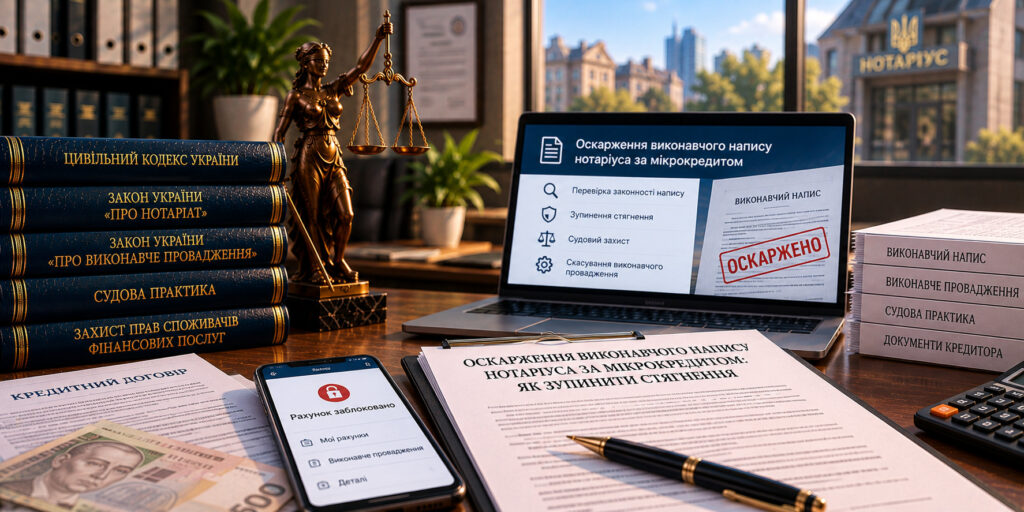
A person may receive no court summons, take no part in any debt recovery case and then suddenly discover in a banking app that funds in their account have been frozen. After checking the details, it may turn out that a state or private enforcement officer has already opened enforcement proceedings based on a notary’s writ of execution.
This problem is particularly common in disputes involving microloans. A borrower may initially receive a relatively small amount, stop making payments, and later face enforcement for a substantially larger debt. The claimed amount may include interest, commissions and other charges, while the claim itself may already have been assigned to another financial company.
A notary’s writ of execution is not a court judgment establishing the debt. If the statutory procedure was breached, the creditor’s documents are defective, or there is a genuine dispute as to the existence or amount of the debt, the writ may be challenged in court. If enforcement has already started, it is also important to consider how to prevent further recovery while the case is pending.
Why a notary’s writ is not the same as a court judgment
A notary’s writ of execution is an enforcement document that may be used as a basis for compulsory recovery. However, the procedure for issuing such a writ is fundamentally different from judicial proceedings.
A notary does not hold a court hearing, hear both parties or resolve the dispute between the creditor and the borrower on the merits. The notary reviews the documents prescribed by law, which must demonstrate that the claim is undisputed.
For this reason, the existence of a notarial writ does not mean that a court has established that the borrower owes exactly the amount stated in it.
When the writ is challenged, the court may examine whether the debt existed at all, whether its amount was calculated correctly, whether the borrower’s payments were taken into account and whether the creditor was entitled to demand that particular amount when it applied to the notary.
Can a microloan be recovered through a notary’s writ of execution?
One of the key issues in microloan disputes is the type of agreement on which the writ was made.
For a certain period, Ukrainian regulation allowed this mechanism to be used for some credit agreements that had not been notarised. Those amendments to the relevant List of Documents were later declared unlawful and invalid.
The Grand Chamber of the Supreme Court subsequently developed the approach that applying those revoked provisions when making a notarial writ constitutes a breach of the prescribed procedure.
This is particularly important for online lending because a typical agreement with a microfinance company is concluded remotely and is not notarised.
In addition, the current regulation of enforcement proceedings separately provides for a prohibition on opening enforcement proceedings on the basis of notarial writs made under credit agreements that were not notarised.
Nevertheless, each case must be assessed individually. The relevant factors include the date of the writ, its contents, the creditor’s supporting documents, the legal nature of the obligation and the version of the law in force at the relevant time.
Why the amount in the writ may be much higher than the original loan
The difference between the amount initially borrowed and the amount stated in the writ does not, by itself, prove that the writ is unlawful.
For example, a person may have received UAH 5,000 or UAH 10,000, while the later claim may include interest, fees for the use of credit, commissions and other charges. In court, therefore, it is not enough simply to state that the debt “increased several times over”. It is necessary to establish how the claimed amount was calculated.
The amount actually received should be compared with the borrower’s payments, the period for which interest was accrued, the contractual terms and the creditor’s calculation. If the borrower made partial repayments, it is necessary to check whether they were properly credited.
A separate issue arises where the original lender assigned the claim to another company. In that situation, it is necessary to examine not only the debt calculation but also whether the new claimant can properly prove its right to demand performance of the specific obligation.
The legally relevant question is therefore not simply why a small loan became a much larger debt, but whether that particular amount could genuinely be regarded as undisputed when the notarial writ was made.
What to do if you first learn about the proceedings from your bank or Diia
If the first warning sign is a frozen bank account, it is important to identify the enforcement proceedings as quickly as possible.
Information about enforcement proceedings may be available through Ukrainian state electronic services. The borrower should establish the enforcement case number, identify the state or private enforcement officer and obtain the resolution opening the proceedings.
That resolution contains an access identifier for information concerning the enforcement proceedings. Using it, a party may access the relevant materials in the Automated Enforcement Proceedings System.
This may allow the borrower to review the enforcement officer’s resolutions, the date on which proceedings were opened, the amount claimed and other documents uploaded to the system.
For the purpose of a future court claim, it is particularly important to obtain a copy of the notary’s writ itself.
What if the notary’s writ is not available in the electronic file?
Ideally, the enforcement document should be available among the electronic materials of the proceedings. In practice, however, the writ itself is not always visible to the debtor in the electronic file.
In that situation, the borrower should not rely solely on the resolution opening the proceedings.
A debtor is a party to the enforcement proceedings and has the right to review the case materials. It is therefore possible to contact the state or private enforcement officer directly and request a copy of the document on which enforcement is based.
For a court claim, it is preferable to have the writ itself, because the claim should identify its number, date, notary, claimant, amount and relevant debt period, and should challenge that specific enforcement document.
If obtaining the document directly from the enforcement officer proves impossible within a reasonable time, it may be necessary to consider requesting that the court obtain the evidence. However, where the document can realistically be obtained from the enforcement file, it is usually better to do so before filing the main claim.
The claim is not ready, but enforcement has already started: what can be done?
This is one of the most important practical points in these disputes.
Preparing a proper claim may take time. The borrower may still need to obtain the notarial writ, the enforcement file, the credit agreement, the debt calculation and other documents. At the same time, compulsory recovery may already be ongoing.
The Civil Procedure Code of Ukraine allows a person to apply for interim measures before the main claim is filed.
This can be particularly important where the situation is urgent and continued enforcement may cause immediate adverse consequences.
One of the interim measures expressly available under Ukrainian procedural law is the suspension of recovery under an enforcement document that the debtor is challenging before the court.
The distinction is legally important. The application is not simply asking the court in general terms to “stop the enforcement proceedings”; it seeks a specific interim measure — suspension of recovery under the enforcement document being challenged.
Why it may make sense to apply for interim measures first
The main court case may take different amounts of time depending on the court’s workload, the need to obtain additional evidence, service on the parties and other procedural circumstances.
If the debtor’s accounts are already frozen and recovery is continuing, waiting for a final judgment may create unnecessary risks.
For this reason, in an urgent case the procedural sequence may be different: first, the minimum documents necessary to identify the writ and demonstrate the risk of further enforcement are collected, and then an application for interim measures is filed before the main claim.
If the court grants interim relief before the statement of claim is filed, the claimant must then file the main claim within the statutory period — within ten days from the date of the court order granting the interim measure.
Interim relief before filing therefore cannot be used simply to put the dispute on hold indefinitely. It is a tool for situations in which court proceedings are already being prepared but immediate action is required to address ongoing enforcement.
Court fees for interim measures also matter in practice
An application for interim measures is a separate procedural document and is subject to a court fee.
At the same time, Ukrainian procedural law contains an important rule: if the main claim is subsequently filed after such an application, the court fee payable for the claim is reduced by the amount already paid for the relevant application for interim measures.
These payments should therefore not be treated as two entirely unrelated fees that will necessarily be paid in full on top of each other.
The exact amount of the court fee should be calculated as of the date of filing, taking into account the statutory rates, the nature of the claim and any applicable exemptions.
On what grounds can a notary’s writ be challenged in court?
In everyday language, people often speak of “cancelling” a notary’s writ. Procedurally, however, the typical remedy is to ask the court to declare the writ unenforceable.
The grounds depend on the documents and facts of the particular case.
Relevant issues may include the fact that the writ was made on a document that did not permit undisputed recovery, the creditor failed to submit the necessary evidence, the debt amount was calculated incorrectly, payments made by the borrower were ignored, or the claimant failed to prove its right to demand payment.
The applicable time limits for making the notarial writ should also be checked separately.
A strong claim should therefore not be based on a long list of abstract objections. It should focus on concrete violations that can be supported by documents.
What if the loan has already been assigned to another financial company?
A change of creditor is common in microloan cases.
The borrower may have entered into the agreement with one company but later see a different entity named in the notarial writ. Assignment of a claim is permitted by law, so the mere fact that the creditor has changed does not make the writ unlawful.
It is necessary to establish whether the assignment was properly documented, whether it covered the specific credit agreement and whether the company that approached the notary was entitled to demand the amount claimed.
This becomes particularly important where the debt has been transferred between several financial companies.
Why one court claim may not always be enough
If enforcement proceedings have not yet resulted in the actual transfer of funds, the immediate priority may be to stop further recovery and challenge the enforcement document itself.
However, if money has already been deducted and transferred to the claimant, a separate issue arises as to how those funds can be recovered.
A court ruling declaring the writ unenforceable may be important for that purpose, but the appropriate mechanism for recovering the money must be determined separately, depending on who received the funds and whether there remains any legal basis for retaining them.
Likewise, successfully challenging the writ does not necessarily mean that the underlying credit obligation ceases to exist altogether. If the creditor maintains that the debt is valid, it may seek recovery through ordinary court proceedings, where the borrower will then have the opportunity to dispute both the basis and the amount of the claim.
When court protection may be necessary
Once the matter has reached the enforcement stage, several categories of documents usually need to be analysed together: the notary’s writ, the enforcement file, the credit agreement, the creditor’s debt calculation and evidence of payments made by the borrower.
In such cases, protection of interests in court may include reviewing the legal grounds for the notarial writ, checking the amount of the alleged debt, preparing an application for interim measures, drafting the main court claim and representing the client during the proceedings.
Time is particularly important once enforcement has started. The main claim deals with the legal validity of the notarial writ, while an appropriately chosen interim measure may protect the debtor against continuing adverse consequences while the court is still considering the dispute.
What to do if your bank accounts have already been frozen
If you discover the notarial writ only after your bank accounts have been frozen, the first step is to identify the enforcement case, obtain the resolution opening the proceedings and obtain the document on which enforcement is based. The creditor, amount claimed, date of the writ, documents evidencing any assignment of the claim and the actual payment history should then be checked.
If recovery is still ongoing, the possibility of interim measures should be considered together with preparation of the main court case. In an urgent situation, the application may be filed even before the main claim, but if relief is granted, the statutory deadline for filing the substantive claim must be observed.
Not every notary’s writ will automatically be declared unenforceable. Likewise, the fact that the debt has grown significantly compared with the original amount borrowed does not by itself guarantee a successful outcome. The result depends on the particular agreement, the creditor’s calculation, the supporting documents, the date of the writ and the contents of the enforcement file.
If your accounts have already been frozen, money is being deducted, or you unexpectedly discover enforcement proceedings arising from a loan or microloan, the lawyers of Grandliga Law Firm can review the documents, assess whether there are grounds to challenge the notary’s writ, prepare an application for interim measures where appropriate, and represent your interests before the court.