



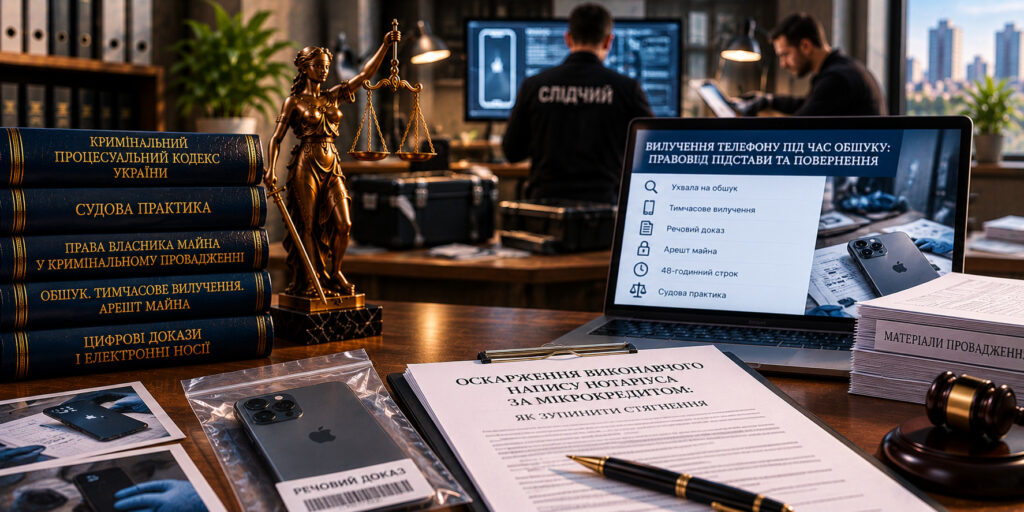
When investigators seize a mobile phone during a search, a practical question arises after the search is over: on what legal basis may the device remain in the possession of law enforcement, and when may the owner seek its return?
The fact that a phone was physically taken does not answer that question by itself. Ukrainian criminal procedure distinguishes between copying data from the device, temporarily seizing the phone, recognising it as physical evidence, and imposing a judicial seizure on the property. These are different procedural mechanisms, and the appropriate method of protection depends on which of them has been applied.
What should be established after the search?
The first documents to review are the investigating judge’s search warrant and the search record.
The warrant shows which items, documents, or electronic media investigators were authorised to search for. The search record shows what was actually taken and under what circumstances.
The phone should also be properly identified by its model, IMEI, and other individual characteristics. The next step is to determine what procedural status was assigned to the device and whether a court subsequently imposed any restriction on the owner’s rights.
What is the difference between copying data, temporary seizure, physical evidence, and judicial seizure?
Copying information means obtaining data stored on the device. In some cases, the purposes of the investigation may be satisfied by the information itself without the need to retain the physical phone for a prolonged period.
Temporary seizure means that the owner is in practice deprived of the ability to possess, use, and dispose of the property until its further procedural status is resolved.
Recognition of a phone as physical evidence concerns its evidentiary value. Under Article 98 of the Criminal Procedure Code of Ukraine, a material object may qualify as physical evidence if it was an instrument of a criminal offence, retained traces of that offence, contains information that may be used as evidence, or meets other statutory criteria.
A judicial seizure of property is a separate measure of criminal procedure that is imposed on the basis of a ruling by an investigating judge or court.
Therefore, an investigator’s decision recognising a phone as physical evidence and a court ruling imposing seizure on that property are not the same thing.
When may investigators seize the phone itself?
The Criminal Procedure Code of Ukraine contains special rules for mobile terminals, computer systems, and other electronic media.
The key question is why investigators need the physical device itself.
Such a need may arise, for example, because a computer-technical forensic examination is required, because the device itself must be examined, because the relevant data cannot be obtained without taking the device, or because access requires overcoming a logical protection system.
If investigators are interested primarily in files, messages, or other electronic data, the possibility of copying that information becomes relevant. The mere fact that a phone contains potentially useful information does not mean that the physical device must remain with the investigation until the criminal proceedings are completed.
Is recognising the phone as physical evidence enough?
No. Recognition of a phone as physical evidence is not always sufficient, by itself, to justify its prolonged retention. It is also necessary to establish the specific evidentiary role of the device, the procedural basis on which it continues to be held, and whether the restrictions on the owner’s rights have been imposed in accordance with the Criminal Procedure Code.
A useful example is the ruling of the Pecherskyi District Court of Kyiv dated 17 March 2026 in case No. 757/52462/25-k, proceedings No. 1-kp-2610/26.
An iPhone 16 Pro Max had been seized during a search on 1 May 2025. The prosecutor objected to its return on the ground that the phone had been recognised as physical evidence. However, neither the prosecutor nor the pre-trial investigation body had applied for a judicial seizure of the device.
The court found that the phone had the status of temporarily seized property and should be returned to its owner. By the time the issue was considered, the device had been held for more than 11 months, the pre-trial investigation had already been completed, and the indictment had been submitted to the court.
The court also noted that formally recognising the phone as physical evidence, without properly explaining which criteria under Article 98 of the Criminal Procedure Code it satisfied, could not by itself prevent restoration of the owner’s rights.
The court therefore granted the application and ordered the return of the iPhone.
The practical point is that evidentiary status matters, but it does not create an automatic and indefinite right to keep the phone. The legal basis for continued retention and the actual need to preserve the physical device must be assessed separately.
When does the 48-hour deadline matter?
For property that qualifies as temporarily seized during a search, the Criminal Procedure Code provides a special deadline for resolving the issue of judicial seizure.
In the situations covered by part five of Article 171 of the Criminal Procedure Code of Ukraine, an application for seizure must be filed no later than 48 hours after the property was taken. If that is not done, the Code provides for the property to be returned to the person from whom it was seized.
However, the 48-hour rule should not be applied mechanically to every phone taken during a search. The legal status of the particular device must first be determined in light of the wording of the search warrant and the circumstances in which it was taken.
For that reason, a dispute over return of a phone is not resolved simply by counting hours from the search. The legal regime applicable to the device must first be identified correctly.
A seizure may have been lawful, but the need for it can later disappear
Even if there were valid grounds for seizure when it was first imposed, that does not mean the restriction must remain in place throughout the entire criminal proceeding.
This is illustrated by the ruling of the Holosiivskyi District Court of Kyiv dated 19 December 2025 in case No. 752/25955/25, proceedings No. 1-ks/752/10503/25.
An iPhone 15 had been taken during a search. By a ruling dated 19 November 2025, the investigating judge imposed a judicial seizure on the phone.
When the later application to lift the seizure was considered, the court found that all necessary investigative actions involving the device had already been completed. In those circumstances, the investigating judge concluded that the continued need for the seizure had ceased.
The seizure of the iPhone 15 was lifted.
The practical significance of this decision is that, once the necessary investigative actions have been completed, it becomes necessary to reassess whether there remains a genuine procedural purpose for continuing to restrict the owner’s rights.
When may the court keep the phone under seizure?
A different result is possible where investigators can show that the physical device is still required for a specific procedural purpose.
This was the situation considered by the Kyivskyi District Court of Odesa in its ruling dated 29 July 2026 in case No. 947/6067/26, proceedings No. 1-ks/947/10693/26.
In that proceeding, an iPhone 14 Pro Max had been placed under judicial seizure. The owner applied to have the restriction lifted.
A computer-technical forensic examination of the phone had been ordered. At the time the application was considered, that examination was still in progress, and the prosecutor explained that the device was required to examine information that could be relevant to the criminal proceeding.
The investigating judge also noted that the applicant had not provided sufficient evidence showing that the need for continued seizure had already disappeared.
The court therefore regarded the application as premature and refused to lift the seizure.
This means that the mere passage of time is not enough to secure return of the device. If a necessary examination is genuinely still underway, that may justify keeping the seizure in place.
What does the comparison of these cases show?
The three decisions concern three different procedural situations.
In the first case, the phone was being held without a judicial seizure, and the court did not regard formal recognition as physical evidence as sufficient justification for continued restriction of the owner’s rights.
In the second case, a seizure existed, but the necessary investigative actions had been completed and the need for the restriction had therefore ceased.
In the third case, the forensic examination was still ongoing, so the court concluded that the need to retain the physical device remained.
The outcome therefore depends not simply on the label “physical evidence” or on the length of time since the search, but on the specific procedural purpose that continued retention of the phone serves at the time the issue is brought before the court.
What documents are needed to address the return of the phone?
To prepare a legal position, it is usually necessary to review:
- the search warrant;
- the search record and description of the seized property;
- the decision recognising the phone as physical evidence, if one was issued;
- the application for judicial seizure and the court ruling imposing it, if applicable;
- information about any ordered or completed forensic examination;
- documents confirming ownership or lawful possession of the device.
If the legality of the officers’ actions during the search itself also needs to be assessed, the procedure for conducting the search, the recording of the search, and any objections to the search record may also be relevant. More detail on this is available in our article “Search of the premises — call a lawyer”.
How should the correct method of seeking return be chosen?
The appropriate next step depends on the procedural status of the phone.
If the device is temporarily seized property and the statutory grounds for continuing to hold it are absent, the issue may concern return of the property and, where appropriate, a challenge to the failure to return it.
If a judicial seizure has been imposed, the issue must be addressed through an application to lift that seizure, with arguments showing that it was unjustified or that the continuing need for it has ceased.
If a forensic examination is objectively still underway, an application to lift the seizure may be premature.
For that reason, such applications should not be prepared as generic templates. It is important first to identify the procedural mechanism applied to the phone and the facts that may support its return. A criminal lawyer can review the search materials and the decisions concerning the seized property and help determine the appropriate procedural remedy.
What should you do if the phone is not returned?
After a search, it is not enough to rely on an oral request to the investigator to return the device. The relevant procedural documents should be obtained and the current legal basis for retaining the phone should be established.
Prompt action is especially important where the device is used for business operations, access to bank accounts, electronic signatures, corporate communications, or other critical functions.
If your phone was seized during a search and has not been returned, contact JSC “Grandliga”. Our lawyers will review the circumstances of the seizure and the procedural documents, assess the possible grounds for return of the property, and help protect your interests.